
Machine Learning Operations is often an underinvested vector that is treated like tech debt, and only supported reactively when it has become a burden to model accuracy, development speed, or customer trust. This article will outline a framework for determining when you should proactively invest in MLOps.
What is MLOps?
Machine Learning Operations is a set of automation and standardization practices that govern how machine learning models get deployed, monitored, and maintained once they're in production. It is the layer that turns a model built in a single development environment into one that performs consistently at production scale. Practices include (but are not limited to):
- Version Control: track source of truth code, datasets and model weights as they evolve over time.
- Continuous Integration/Continuous Deployment Automation: automatically test data, validate models, and deploy updates safely to reduce production downtime or breaking errors.
- Continuous Monitoring: track production performance over time to detect when a model needs retraining.
What does MLOps contribute to the business?
MLOps infrastructure protects the business against two separate risks:
- Data drift introduced by data variance over time, which silently decreases model accuracy when left unresolved. Monitoring and automated regression tests catch this.
- Scaling issues, which show up when models have to be updated and retrained manually as they evolve or expand. CI/CD, shared libraries, and training orchestration turn ad hoc expansion into a repeatable process.
When to Invest in MLOps Infrastructure
MLOps infrastructure is typically built retroactively, once its opportunity cost has been realized by the business in lost efficiency, development speed, or customer trust in the model's accuracy. Businesses can get ahead of this by looking for two proactive signals:
- Is the deployed model customer facing? If so, that comes with certain service level agreements to customers that can only be measured and enforced with MLOps. SLAs typically include:
- Model Accuracy - minimum threshold for model performance (e.g. F1 score or precision)
- Data Quality & Drift - limits on missing values or severe data drift that can degrade model prediction accuracy.
- Does the model ship once, or is retraining part of its design? Models trained once only incur the static cost of building. However, models that are designed to be updated (e.g. retrained, expanded, or redeployed as new versions) repeat the same process for every update, so any manual debt compounds per iteration.
Here's how opportunity cost breaks down across signals:
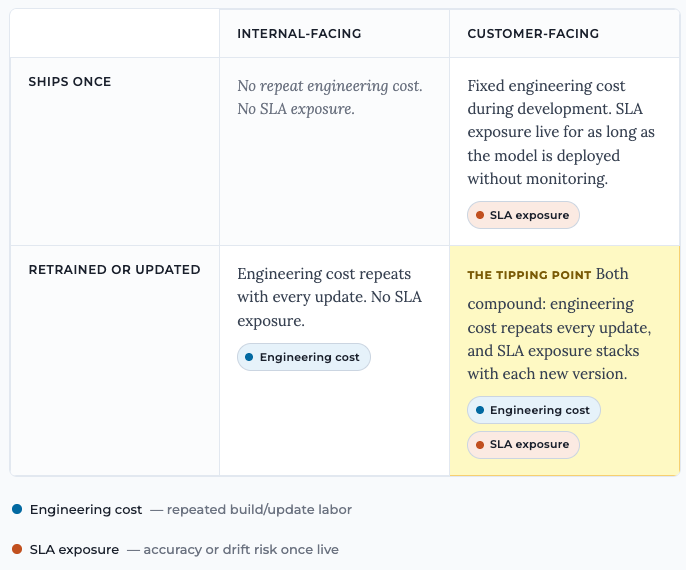
The convergence of signals is the tipping point, when the opportunity cost of MLOps implementation actively slows down how fast the business can expand.
The Tipping Point in Practice
Let's observe how these two signals show up concretely in practice within a single business at varying decision points.
An e-commerce platform runs a single customer-facing production model that scores the likelihood a given cart converts to checkout, based on behavioral features like time on page, cart size, and return-visitor status. The platform uses that score to decide which carts get a discount nudge, so an incorrect score means the platform makes the wrong call to serve the customer a discount and the business loses unnecessary revenue.
Implicit SLAs
What this looks like in practice
- Customers expect the model to meet minimum accuracy thresholds, even though no SLA is explicitly stated.
- There's no plan to retrain the model on a schedule.
- No plan to extend it to new signals or launch new versions for other merchant segments.
Problem
- The business hasn't defined minimum accuracy, how it will be measured, or what to do if the threshold isn't met.
- When the platform streamlines checkout to optimize for speed, the model's measurement of time on page diverges from how it was defined at training.
- No monitoring or alerting exists to flag that accuracy has fallen below an acceptable threshold.
Solution
- Set a minimum accuracy floor, measured with a rolling comparison between predicted and realized outcomes.
- Measure data distributions of key features over time against the training baseline to catch drift.
- Trigger a review and retrain on updated data once either threshold is breached.
Proactive MLOps infra build before expansion
What this looks like in practice
- A year after Scenario 1, the platform commits to a growth plan built on signing customers in new merchant categories.
- Each new category needs its own version of the conversion model.
- Every new model is held to the same accuracy and drift-tolerance SLAs as the original.
Problem
- Without MLOps, each category expansion means ad hoc model development and deployment.
- No shared training path or continuity checks across versions.
- The Scenario 1 risk compounds across every new category.
Solution
- Build the shared infrastructure before the first new category launches: training orchestration, a model registry, CI/CD gates.
- Gates block a new version if it fails the same drift checks the original model relies on.
- Reuse feature and preprocessing code across category models, speeding up every subsequent deployment and keeping the fleet consistent.
Retrofitting MLOps infra after expansion
What this looks like in practice
- Same starting point as Scenario 2: customer growth depends on expanding the model into new merchant categories, same SLAs apply.
- But no shared infrastructure gets built before expansion starts.
Problem
- Each new category model gets built ad hoc, copying and adjusting the most recent deployment by hand.
- Within a year, a dozen models are live, none sharing a training path.
- Neither the continuity checks nor the drift checks the original model relied on were extended to the new ones.
- One model incorrectly scores an entire category's carts for a month before a customer files a complaint.
Solution
- Audit every live model for similar degradation.
- Consolidate all of them into the same shared pipeline as Scenario 2: training orchestration, a model registry, shared feature and preprocessing code. Deprecate the forked models.
- Gate new deployments with CI/CD drift and continuity checks.
- None of this is optional, and it now competes directly with new category commitments.
How timing changes the outcome
The matrix shows that a business has reached the tipping point, but it does not show what it will cost. Cost depends on timing - specifically if the investment to build MLOps happens before or after the expansion decision, when every new model starts inheriting the same SLAs. The timeline below follows both paths from that same decision to the full MLOps build, but at very different costs.
Illustrative: shows the shape of the story, not measured data.
Both Scenarios 2 and 3 end up with the same infrastructure, but Scenario 2 requires a single build while Scenario 3 involves substantial auditing before remediation is possible. Deferring MLOps investment to later in the growth cycle turns a simple infrastructure build into a complex and expensive project.
Weighing whether your model needs MLOps investment now or later? Get in touch - we'll help you work through the specific tradeoffs for your project.